


Understanding the Lie: Why Truth-Telling and Trust Go Hand in Hand
Lying is the telling of a false statement with the intent to conceal, placate, or safeguard.
There comes a moment in every lie that you wish you had just told the truth. Perhaps you’ve experienced this – the desire for the relief of putting all your cards on the table. The space between you and the person you’ve lied to suddenly feels more distant than it did before, and you’re recalling the moment you chose to lie. Why did it seem so daunting? Why hadn’t you simply told the truth?
Mom confronted our lies because she knew the freedom that came with embracing truth, no matter how scary it felt at first. She created a safe place for us to come to her, becoming a person we could trust to model how we could be trustworthy ourselves. This didn’t mean our lies didn’t have consequences, but rather, the importance was placed on the trust broken by the lie. It cultivated character while it built the better habit.
So why do we do it? Why do we lie, and why is it so important that we as parents confront it in our children?
Why We Lie

As a child, I would imagine that you were not afraid of the light. Rather, as most of us were, you were afraid of the dark. In the dark, nothing is sure. It is a place that things hide, and a place we hide things, sometimes out of fear that we will be found out, but sometime because it does not feel safe to reveal something in the full light of its truth.
It is true that a child lies because they really did break the vase, and know that when discovered they will face a consequence. But there is another aspect that we as parents must be sensitive to: are they afraid to come to us? Have we stopped becoming a safe and trustworthy place? Is the child lying out of deception? Or out of fear?
Truth-telling is difficult in light of that fear, and we must be compassionate to that reality. Truth always reveals and clarifies, where deceit divides and distorts. Truth brings light and allows for freedom and restoration. But, if peace and restored relationship is not the outcome a child faces when being confronted with the lie, if they do not understand that truth telling is done for the sake of these outcomes, then they will come to fear and avoid the consequence.
“Truth always reveals and clarifies, where deceit divides and distorts. Truth brings light and allows for freedom and restoration.”
It is our job then, not only to address the habit of lying, but to teach our children that truth brings freedom. Why? Because it is the heart of God. We are able to come to God with our mess and mistakes. He warmly welcomes us in and rejoices in our turning to Him, even as He corrects us. He corrects so that we would be able to draw nearer to Him.
We get to reflect that same heart to our children, and to model it in a tangible way. In time, as they leave our home and turn fully to rely on the Lord, they will know what it is to draw near to God, and live in peace with mankind.
But first, we must recognize the lie.
The Anatomy of a Lie
Growing up, Mom taught us two foundational realities of a lie.
A Lie Always Gets Found Out
Have you ever seen a young child try to lie? They’re terrible at it! Yet they are so convinced that their lie is convincing. The lie is easy to spot because you know what your own guilt feels like. And just like a fever, once you’ve had it, you can spot the early signs in someone else. Some physical signs include:
- Lack of eye contact
- Trying to move or pull away from you
- Shrinking back from questions (I’d add being vague, or shifting the attention to someone/thing else)
Conviction is like a voice of inner conscience declaring truth, even when we are trying to absolve ourselves with a lie. Your child is feeling it even if they do not have language for it.
If ignored, your child will numb it out the voice of conviction. It is why it is important to teach them even when the lie feels small. We want them to know that lies will not be ignored, but must be confronted. And we must give them the language to understand the still, small voice prompting them towards truth!
A Lie Always Gets Tangled
Even the most well fabricated lie trips over its own shoe laces. One lie always forces another to be made, and the layering web of untruths becomes an elaborate story to uphold. Not only does it get harder to remember, but the bigger it becomes, the easier it becomes to spot.

Mom taught that truth telling was always the easier option. Truth cuts a straight path through the cobwebs, and leads to resolution. Deceit divides, it hinders us from being in relationship with one another when we have to maintain a story for the sake of temporary peace. It doesn’t avoid consequence, often, the weight of lying is heavier than the natural consequence of the action.Though hard to face at first, freedom was the result of truth telling. It was a lesson that we had to learn over and over again.
Practical Theology
In the Garden of Eden (Genesis 3), God confronts Adam and Eve in their sin. They disobeyed His command, but then they attempted to hide their sin from God. They were naked and ashamed. There would be a natural consequence to eating from the tree – with their new knowledge they would have to bear the hardship of a life separated from God. They could no longer stay in the Garden with Him.

But God also sought after them in their shame and their hiding. He made a way for restoration in Christ, and set a grand plan in motion for them to be united back to the freedom and intimacy of the Garden. In the same way, we get to model for our children what God will do for the rest of their lives: seek them, find them, and if allowed, restore them back to Himself.
Children tell small lies, and sometimes ridiculous lies. Seems like some heavy theology for a “did you break that vase?”
The confronting and untangling the lie displays to your children the same heart of God that grieves sin, and wishes that they would have come to you for help rather than choosing to hide in shame or deceit. It creates a pattern for restoration, teaches them to recognize conviction, and also to recognize the consequences of the lies: broken trust. More about that later.
How to Address Lying
Equipped with this knowledge, what does the confronting of a lie actually look like?
Stop Everything
If we lied to Mom, she would stop everything to sit us down. She would move so she was at eye level with us. As children, this meant sitting on the floor. As we got older, it would be sitting on opposite ends of the couch, or at the dinner table. She turned her whole body towards us – we knew we had her full attention, which told us that this was serious. And if we went to move away, she gently but firmly set our focus back to the conversation by holding us, or moving to a place that had less distractions.
She would clarify for other siblings that she needed to talk with the child who had lied, further impressing the serious nature of the conversation. Then, she would start asking questions.
Allowing For Confession
The first question we were always asked was, “are you lying to me?”. We were always given the opportunity to turn to her in truth. There would still be a consequence, we had, after all, still lied. But the consequence would be for the action that instigated the lie (hitting our sibling, taking a toy, etc.), not the lying itself.
Typically, it was a natural consequence. For example, if we hit, we were going to play somewhere else. But if we hit and then tried to hide it, Mom’s attention would turn to the lie itself.
Ask Simple Questions: The Conversation
Mom knew we were lying. If we didn’t choose to admit to our lie, then we were in for a much longer conversation. It was like coming before a trial judge, asking us to account for where we were, what we were doing, and when. We could deny all we wanted, but ultimately, Mom had the eye witness account.
The questions were meant to reveal to us the first truth about a lie in real time: lies get tangled. Usually, the shorter the question, the clearer the answer, and the clearer the lie. Let’s say we took a toy from our sibling, and now the sibling is upset. The crying would let mom know there was something to attend to. This is how our conversation with Mom would have played out:
Mom to Child A: Why is Child B crying? (initiating the conversation, getting on our level)
Child A: I don’t know. (holding a toy)
Mom Asks Both Children What Happened (gather information of what happened to give each child the opportunity to confess)
Child B: Child A took my toy.
Mom to Child A: Did Child B have the toy first?
Child A: No.
Mom to Child A: Help me understand why Child B is crying if you didn’t take their toy.
Child A: I think they got hurt.
Mom to Child A: But they said you took it, and I see it’s in your hands. Are you being honest with me, or is there something else you want to say? (a non-threathening invitation to add more and a way back to truth)
Still to Child A: Remember, you have two choices. (Mom would hold up two hands to give us a visual of our choices. Then she’d put one hand out to indicate our choice) If you choose to be honest and really tell me what happened, even if its hard to say, there will be a consequence for your actions, but it was be simple and the trust we have between us stays intact. (Mom holds out the other hand) If what you’re saying isn’t true, then there will be other consequences because I need you to understand that lying isn’t okay and hurts our relationship.
The possible outcomes of this conversation are that Child A confesses, and the consequence is that they lose the toy, and have to apologize to the sibling for taking it from them. If Child A continues to hold fast to not telling the truth, Mom would sit and talk until the lie surfaces. She would keep asking questions from different angles, and eventually, the truth comes out because a lie doesn’t add up, and gets tangled.
Then, there would be a conversation on how destructive a lie is relationally, why we as parents must deal with it for their future self. Mom would end voicing her hope that the child would choose differently next time.
The conversation doesn’t stop there. Once the lie was uncovered, the conversation would shift from finding out the truth to applying consequence and reconciling the children together.
As you saw in the above conversation, a lot of lying dealt with relationship, not just a blanket statement of “lying isn’t okay”. Mom laid out a roadmap so that we would understand why we were having the conversation, and what it meant to come back into relationship with the person we had lied to.
Correction and Reconciliation
Withholding truth for the sake of pride or self-protection produced a long and exhausting conversation, not only with Mom, but also internally as we tried to maintain our story. The easier way was always to accept the correction and be reconciled. As young children there was a very practiced conversation, but it made all the difference as we got older and we felt the relational distance and mistrust that a lie produced.
Let’s pick up from where we left our conversation with Child A. We left off having uncovered Child A’s lie, and are now going to correct and reconcile the siblings to one another.
Mom to Child A: I understand that you wanted the toy, but it’s not okay to just take it because you want it. If someone else is having a turn, you must be patient and wait until they’re done to have a turn with it. Would you want someone to take it from you because they wanted it?
Child A: No.
Mom to Child A: Okay. Let’s go apologize to Child B for taking their toy.
Mom would bring the children together and walk through the apology, having each child repeat after her to learn the cadence of the apology. It was not enough to say “sorry”, we needed to acknowledge what we had done.
Mom to Child A: Can you say “Child B, I’m sorry for taking your toy” ?
Child A: (mumbles) Sorry.
Mom to Child A: Let’s try that again. You need to look at Child B and say what you’re sorry for. They need to know that you mean it.
Child A: I’m sorry for taking your toy.
Mom to Child A: Thank you. Now –
Mom to Child B: Can you forgive Child A for taking your toy?
Child B: Yes.
Mom to Child B: Okay! Can you say, “I forgive you” to Child A?
Child B: I forgive you.
Once again, while formulaic in nature, this cadence would be one we would need to be familiar with. From there, Mom would administer a consequence for lying.
One that we often used was the sentence method. Mom would have us sit down and write out “I will not lie to Mom” a set number of times. The first time we had to write the sentences wasn’t hard, but if the habit of lying perpetuated, the number we had to write would increase. Each new time we confronted the sentence was harder because we knew the discomfort of sitting at the table, separate from the fun, and having to write the same truth over and over again.
Building Back Trust
Lying also meant that we had also fractured Mom’s trust in our word. Think of it like a block wall. Stacking blocks on top of one another links them together and creates something strong and dependable to build upon.
A lie breaks the wall. It requires work to build it back up again.
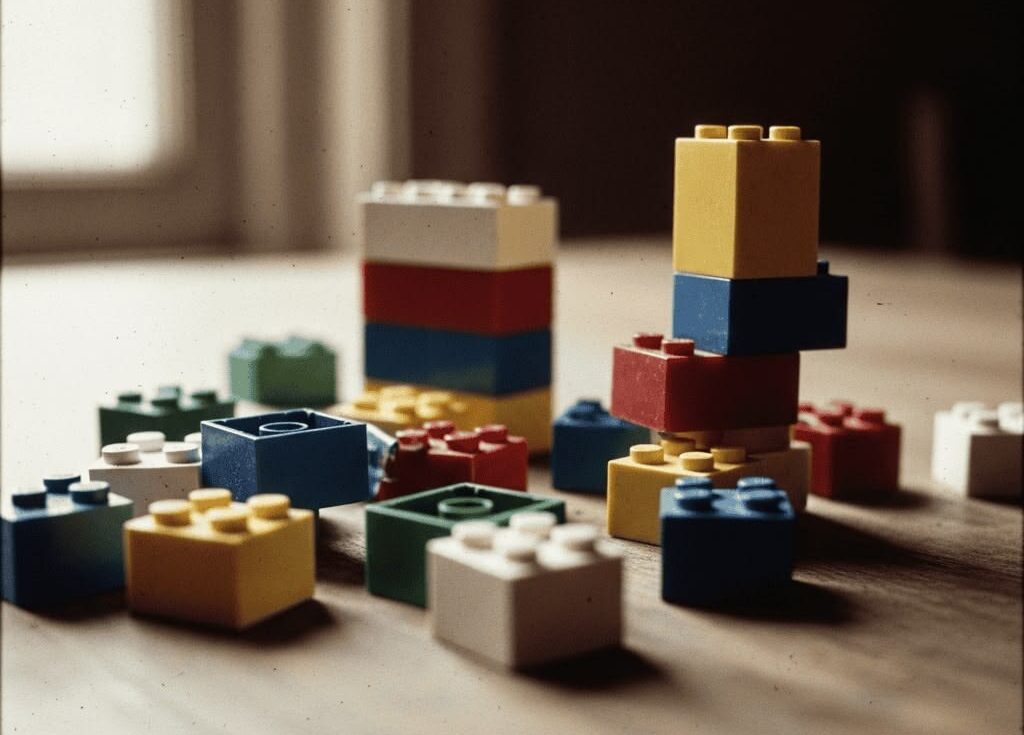
Build trust can be re-established with consistent, genuine, good-willed effort. Understanding this concept of trust did more than any grounding or timeout could have. It required us to come with a contrite and repentant heart that showed that our action moving forward would truly change. We weren’t supplying lip service to sidestep accountability.
Like a repentant heart before the Lord, we had allowed the lesson to sink into our heart and redirect our steps. We were putting in the effort to build back relationship lost in the lie. And that was always the goal.
A Final Encouragement
As you saw with the example conversation, lies are often interwoven with other micro-teachings. They can feel clunky to address, and complicated to explain in the language of your child. But children are smart! Being consistent and impressing the importance of being truthful will preach well beyond having a perfect theology.
Mom didn’t have a PhD in psych or child development. She had a vision of what our home could look like, grounded in honesty with one another, and a desire that we would know God’s heart for us. She cultivated a home where we did not need to hide, and now as adults we can bring things to one another in love and in truth.
That is why she did it. And we believe that you can too!