


Confronting Cruelty: Because Home Should Be The Safest Place For Your Children
It’s another day of fighting in your house. Children fighting over toys, fighting over their seat at the table, their turn on the swing. They are quick to grab, quick to push, quick to hit.
Why is there a natural bent in children to be cruel?
We use the word cruelty because it implies intentional action, not just circumstantial or accidental hurt. The type of cruelty we are talking about is the natural human bent to be selfish and abuse or leverage the power they are given for their own benefit.
Let it be noted that we are not talking about emotional, verbal, or physical abuse. If you believe your child is acting in response to abuse done to them, or there is something deeper motivating your child the normal fleshing out of childhood dynamics, please seek professional help.
Cruelty is one of the easiest actions to spot because there is design by the child and often a reward to their action. A child hits their sibling because they are playing with a toy they want. The youngest sees that a sibling is going to sit in a chair and rushes to take the seat instead.
Sometimes it arises because there isn’t language enough to convey a need or a want, and so the request becomes emotional and takes on a physical nature. Sometimes it is a child leveraging positional authority as the youngest child, or oldest child.
Left unchecked, cruelty becomes selfishness. You will have a child that grows to have no consideration of others, or if there is consideration, one that benefits them at the expense of others. They will have little value of other people, because at its base, cruelty is a devaluing of someone else in favor of yourself.
But that outcome is avoidable, because consideration is something that can be taught! As with all things it takes diligence, but it also requires a heart that is tender towards your children. This is not a “fire fighting fire” situation. Instead, this is a training up of kindness that we ourselves can model, and therefore expect, in our homes.
Home Should Be the Safest Place
Mom’s philosophy was that home should be the safest place to be, for each one of us. The expectation of home was a place where you didn’t have to be on defense. The baseline experience was one where each person was loved, and honored.
We knew growing up that each one of us was prized by her, inherently valuable, made in God’s image. So any illogical, malevolent, or manipulative cruelty would not be tolerated. We could not use our position as oldest, youngest, best behaved, smartest, prettiest, kindest, as a free pass. We were required equally to be considerate of one another.
If we were not, we understood that Mom would protect us, even if it was from one another. Our value was impressed upon us daily in her word and her action, and it set the precedent of how we would treat one another.

Mom knew adulthood was full of injustices and cruelty. Our intentions in childhood were clearer to understand than the murky waters of adult motivation, and she wanted us to know that the value we had was worth protecting. She took time to cultivate home so that when we confronted the world, we had a baseline understanding of our worth. It also gave us a place to return to that dignified us and was forever safe.
How Mom engaged with cruelty also cultivated a sense of righteous justice – just because someone was younger, smaller, weaker, or different, did not give cause for advantage to be taken and power abused. When we left home, we were sensitive to how people treated us, and how they treated one another. Because of it, we knew how to see people and be a safe place for them. It has made us excellent friends, confidants, and has given us eyes to see the marginalized.
The Value of People, Imago Dei
The value of people was something Mom taught us in the home, yes, but also in daily interaction. Driving by the homeless, bring water to construction workers, being a friend to children at the park, opening the door for a lady with groceries, she taught us that consideration was not just for our siblings, but a way of living that was expected.
Not always because we loved them, in many cases we didn’t even know them. But because God created people in His image, and called them “very good” (Genesis 1:31). We got to honor that in our kindness to others, and in the ways we could extend our time, energy, and effort, even when it inconvenienced us.
In this way, Mom extended kindness from just doing what was kind or noble, to softening our hearts and giving us eyes to see and love the way God loves others. It also meant that the rules of home extended beyond our siblings, but touched at how we were going to live beyond it.
Remember, You Guys Love Each Other
One of Mom’s redirects when she found us being unkind to one was this phrase:
“Hey, that’s not kind. Remember, you love your sister, we don’t treat someone we love like that.”
Packaged in that one phrase were many expectations and reminders.
First, there was a response to our action. The “hey” was usually accompanied by Mom picking us up, or moving us away from the sibling we were being unkind to. Not with aggression, but quickly and firmly. It signaled immediately that that action would not be tolerated.
If it was something unkind that we said, the same thing would be done. The moving is what signaled that we had done something that was not okay, and would not wait to be addressed.
Second, Mom asked us to remember our love for the person we were taking advantage of. This wasn’t based on the action, this was an expectation of relationship. We were taught that the relationship we had with our siblings was one of love, and that love should lead and guide our actions.
Finally, Mom connected the two ideas. Because we loved the person, our actions should reflect that love. From there, Mom led us back to the sibling to apologize, or to resolve conflict further.
A Play by Play
With that backdrop in place, let us move to what steps Mom moved through when confronting us in cruel action.
Face to Face
If we were mean to one another, in word or in action, we would be brought face to face. If hitting was involved, Mom would hold our hand so that we were not tempted to again in the height of our emotion and the opportunity of close quarters.
The purpose of looking at one another was for the perpetrator to confront the effects of their action, to not run away and become disconnected from it. Usually the person they had been mean to was crying, or visibly upset. It was uncomfortable, and it was meant to be. She often said, “look at them,” and would wait until we did.
As we got older, instead of Mom bringing us together, she started having us go to the other person, exercising the Biblical precedent to resolve conflict face to face.
Cultivating Compassion
Next, Mom would verbally walk us through the principle of “do unto others”. How would we feel if we were shouted at? Would we feel sad if we were pinched? Would you be mad if they took your toy, even if they knew you wanted it?
She was training an ability to see the other person, to look beyond our own self centeredness, to consider the consequence of our action before we did something in anger. It was a foundation that she would gently point back to as we got older, to include compassion in our consideration.
Genuine Apology
In order for there to be a change in action, there needed to be a change in heart. We were not allowed to move on until an apology was offered, and forgiveness extended. And it needed to be offered with a tender heart. No mumbled apology, no sideward glance. We had to look them in the eye and clearly say we were sorry for the action, and the result of what we caused.
Mom would often ask us to repeat after her so we became familiar with the language: “I am sorry that I hit, will you forgive me?” and “yes, I forgive you, thank you for saying sorry”.
Reconciliation
When we were little, Mom would make us hug until we giggled. It’s hard to stay mad at someone when you were squished together!
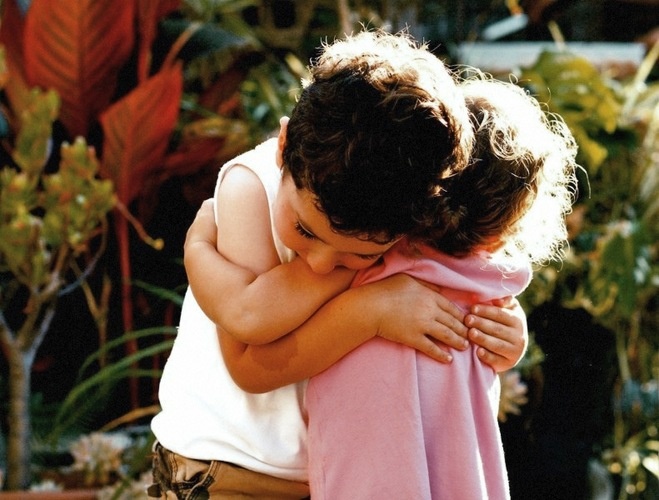
As we got older and hurts became more verbal than physical, we would often ask the question: “do you feel resolved”? It was invitation to put everything on the table, to not leave something tucked away in bitterness to fester. It offered the chance for the other person to bring up an angry word said earlier, a passive aggressive comment, or even a feeling that, though unintended, was still lingering.
Mom is a Person Too
Mom included herself in her response to cruelty. She did not allow injury or insult to be inflicted upon herself just because she was Mom, and if ever an occasion presented itself, she would ask Dad to step in as mediator. Just like we knew that Mom would defend us against each other, we also knew that it was Dad’s job to defend Mom, even if it was against us.
As teenagers this also encouraged us to be considerate of our parents in conflict. Mom allowed us to see the impact our words and actions had on her, and it taught us that she was more than just a figurehead, but a person with feelings, just like us!
Rules of Engagement
When children are young, you are teaching them the rules of engagement. But as they get older, you shift from being a teacher to a mediator. It’s like being the driving instructor during Driver’s Ed to being the officer on the road when they speed past. You are first responsible for teaching them the rules and the consequences, and then upholding them.
This also requires that you uphold the rules as a keeper of the law. The Mom Card of “do it because I said so” can’t be pulled, otherwise there will be no heart change. The administration of correction is meant to teach, and it means putting aside your own emotion to disciple your children after the heart of God. Fair, but willing to allow us to feel consequence for the sake of change.
A Final Encouragement
Your children are not bad kids. They are either motivated by the need to feel safe, or they are working out the natural selfishness that we are born with. Both require your guidance as a parent to establish a home that is peaceful and restful for your child, and to lead them back to their love for one another.
Not only will this lay the foundation for how you will engage with one another, but it will set the precedent for how your children understand their value in the midst of hard, cruel world. Let us give them the tools to be tender hearted, and to go out into the world with boldness!